
Mining Operations
- 20 excavators owned
- Works on your lease or ours
- Overburden to hopper
- Ten states of rock
Nobody driving a finished carriageway thinks about the hole it came out of.
Before a tonne of GSB exists somebody has to open a face, strip the overburden, drill it, shoot it and haul the rock to a hopper, and most of the failures that turn up further down the line start right there: a crusher running half empty, a grading that will not settle, a laying gang standing about with nothing to lay.
We have worked at this since 2000, on our own leases and on client leases, across ten states. The order of operations does not change from one site to the next. The rock does, and the rock sets the drill pattern, the wear rates and how many days of the month you actually produce.
What we bring to the site
- 01
Opening a face
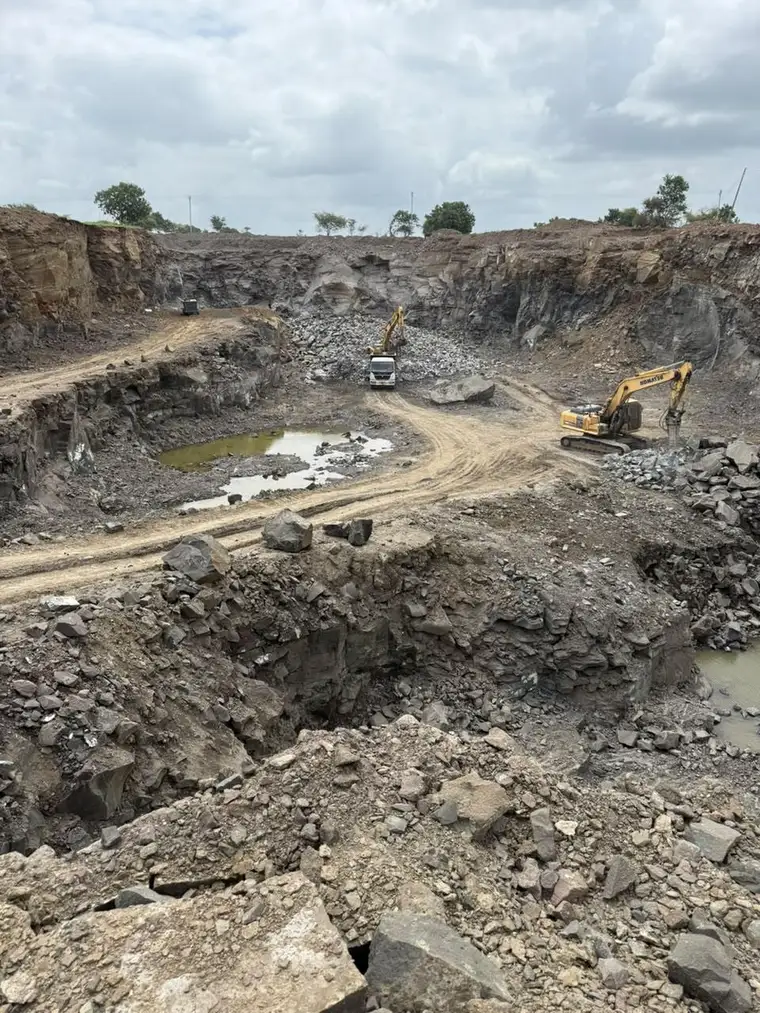
Survey, then benching, then overburden off until sound rock is exposed. On most sites that is two to four weeks before a saleable tonne moves. Better to hear the figure now than with the plant already erected.
- 02
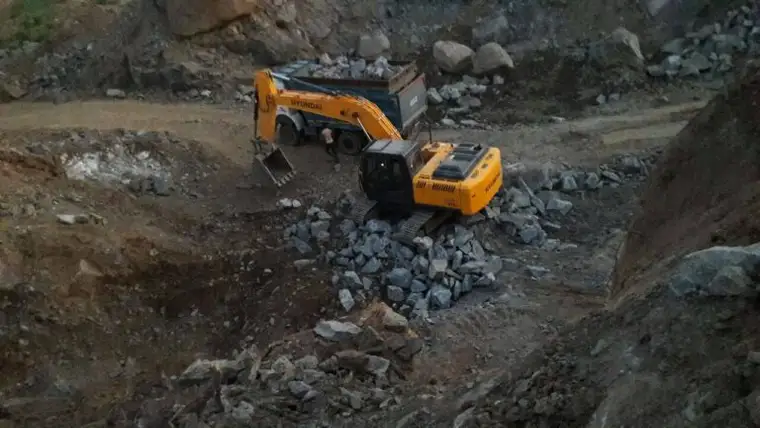
Twenty excavators
Komatsu, Kobelco and L&T, twenty of them, sized from face loading down to trimming a bench. All owned, so availability is something we fix in our own workshop rather than a line in your risk register.
- 03
Your lease or ours
Client-held leases are the usual arrangement: the mineral stays in your name and we produce against it. Where a client has no appetite for running a quarry, we work our own leases and sell tonnes instead.
- 04
The paperwork that stops production
Royalty returns, transit passes, district permissions, the magazine licence for explosives. Dull work, and the commonest reason a quarry stands idle with a new plant erected over it. Each file has a name against it here.
- 05
Rock we have worked
Samruddhi Mahamarg basalt. Granite in Karnataka, sandstone through Bundelkhand, hill rock up in Manipur. None of them behave alike, and fragmentation, wear rates and crusher settings were worked out again on every one.
- 06
Restoration
Benches left at a safe angle, faces stable, the pit handed back in a condition that will not become an argument between the lease holder and the district office after we have gone.
How a job actually runs
- 01
Survey and assessment
Rock type, overburden depth, how a loaded tipper gets in and out, where the water sits, whether a plant can stand anywhere at all. Most of the cost is decided on this visit.
- 02
Mobilisation
Machines, plant and crew move in. Camp, fuel, workshop and magazine go up before production starts, not alongside it, which is how a site loses its first month.
- 03
Clearing and benching
Overburden off, benches cut to a geometry that can be worked safely and repeated. Improvised benches are how a rig ends up somewhere it should not be.
- 04
Drill and blast
The pattern is designed backwards from what the crusher wants to swallow. Oversize looks cheap at the face and expensive at the hopper, where a breaker deals with it and everything behind it waits.
- 05
Load and haul
Excavator to tipper, tipper to hopper. A short lead and a graded haul road shift more rock in a day than an extra machine on a bad one.
- 06
Hand back
Faces stabilised, benches left safe, the ground cleared of our steel.
Mining questions
01Can you work on a lease we already hold?
That is how most of our work runs. Lease and mineral stay with you, we bring the machines, the plant and the crew and produce against it. Royalty and transit paperwork gets handled whichever way the lease is held.
02How long from award to first tonne?
Three to six weeks on a site with nothing unusual about it. Two of those weeks are mobilisation. The rest goes on stripping overburden and cutting a bench you can work from. A poor approach road or a start inside the monsoon adds to it.
03Do you hold your own mine leases?
Yes. One of them carries a plant at Barmer in Rajasthan that has been producing since 2008.
Usually goes with
Drilling Services
Ten rigs with compressor backing. Every hole collared where the pattern puts it, drilled to the depth and inclination the pattern asks for, and logged.
Controlled Blasting
Shotfirers who hold licences, a design worked out for the bench actually standing there, and a vibration reading filed for every round fired. Rock broken, nothing else.
Get a rate
Need mining on your site?
Enough to price the job properly, and enough to say honestly if we cannot take it. Send it before 6pm and you will hear back the same day.
- Location
- and the lead to the road head
- Grading
- GSB, WMM, 40 / 20 / 10mm
- Tonnage
- a month, not in total
- Start date
- and how firm it is
Not ready for a rate? The questions buyers ask cover capacity, how long mobilising takes, leases and how billing works.
Read those firstOr call +91 93093 43222 · Monday to Saturday, 9am to 6pm