
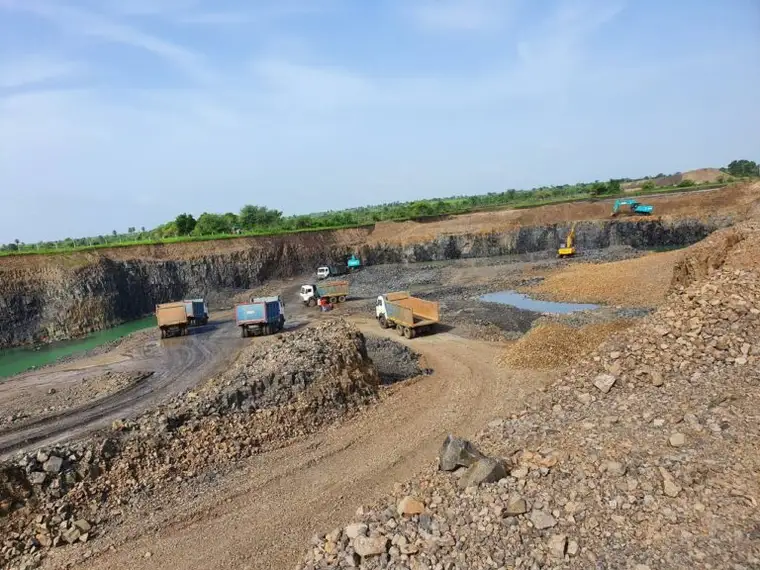
The short answer
A captive quarry with a plant on site pays when the package needs several lakh tonnes, the nearest commercial plants are a long haul away, and there is rock within a short lead that can be permitted in time. Buying in is better for smaller quantities, short programmes, or where good plants already stand near the alignment. Many packages do both, buying for the first months and producing from their own source afterwards.
The decision is usually made in the first month after award and lived with for three years. It rests on five questions, and only one of them is about price.
01The five questions
| Question | Points to a captive quarry | Points to buying in |
|---|---|---|
| How much stone? | Several lakh tonnes over the package | A lakh tonnes or less |
| How far are existing plants? | Beyond 40 to 60 km of the alignment | Several within 30 km |
| How long is the programme? | Thirty months or more | Under eighteen months |
| Is there permitted or permittable rock nearby? | Yes, with a clear route to clearance | No, or the land is in dispute |
| Is the rock proven? | Tested and inside the limits | Unknown until opened |
02Lead is most of the price
The delivered cost of bought-in stone is the price at the plant plus freight, and freight climbs with every kilometre. A captive plant beside the alignment replaces a 50 km haul with a 10 km one. On a few lakh tonnes that saving pays for a good deal of mobilisation. On a few thousand it pays for nothing. How lead works on the rate is in lead and lift.
03Time is the hidden cost
A quarry cannot produce until it is permitted, and permission is several separate approvals from separate offices: the mineral concession or permit, environmental clearance, consent from the pollution control board, the mines safety notice, and an explosives arrangement. Each takes weeks to months. The sequence is set out in opening a quarry for a highway package.
So the comparison is not between a market price today and a captive cost today. It is between buying for the whole job, and buying for six or eight months while the captive source is brought into production. Contractors who assume stone from their own quarry in month three are usually buying in month nine at a rate nobody negotiated.
04The rock may not cooperate
A hillside that looks like sound stone can turn out to be weathered to depth, or to give a flakiness or water absorption result outside the limit for bituminous work. An existing plant has years of test history. A new quarry has a few samples. Before committing, core or pit the site, test the rock for the layers you intend to use it in, and assume the first benches will be poorer than the ones below.
Rock that passes for GSB and WMM but not for the bituminous courses is a common result, and a workable one. The captive plant then makes the granular layers, which are most of the tonnage, and the better stone is bought in.
05What a captive operation needs from you
- Land for the pit, the plant, the stockpiles and the dump, with a road a low-bed can use.
- Someone whose job is the permits and the monthly returns.
- Power, or the diesel budget for generators.
- A mining and crushing team, your own or a contractor's.
- A plan for the pit when the package ends.
The fourth item is where most main contractors stop. Quarrying is a different trade from road building, with its own regulator and its own ways of going wrong. The usual arrangement is that the main contractor holds the lease or permit and a specialist firm produces against it, paid per tonne. That keeps the mineral in the contractor's name and the production risk somewhere else.
06The hybrid that most packages end up with
- At award, sign a supply contract with an existing plant for the first six to nine months.
- In the same week, start the permit file for a captive source.
- Mobilise the plant when the permits are a few weeks from complete, not before.
- Run both for a short overlap while the new plant's grading settles.
- Keep the outside supplier on a reduced quantity for the bituminous sizes or as cover for breakdowns.