
The short answer
A bench should be no higher than the machine working it can safely reach and scale, wide enough for the loader and a tipper to work with a berm at the edge, and cut at an angle the rock will stand at. Under Regulation 106 of the Metalliferous Mines Regulations, soft ground is limited to benches of 1.5 m or a slope of 45 degrees, and working with deep-hole blasting or heavy machinery needs prior notice to DGMS and runs on the conditions it sets.
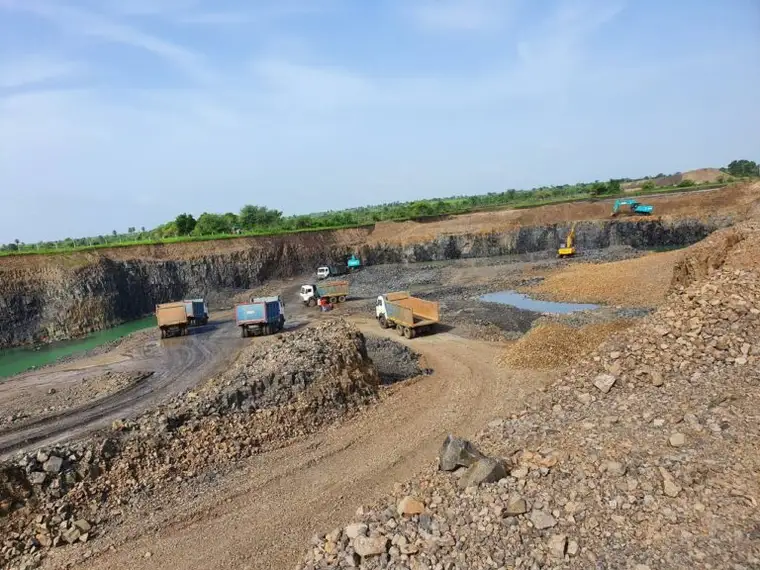
A quarry is a staircase cut into rock. The height of each step, the width of each tread and the angle of each riser decide how safely it can be worked, how well it blasts and how much stone is left behind in the walls.
01The parts of a bench
- Face. The near-vertical wall of rock being worked.
- Crest and toe. The top edge and the bottom edge of the face.
- Floor. The level surface the machines stand on, which is the top of the bench below.
- Berm. A strip left along an edge. A raised berm at the crest stops vehicles and loose stone going over. A catch berm on a finished wall stops falling rock reaching the floor.
- Overall slope. The angle of the whole wall, from the top crest to the bottom toe, including all the berms. It is always flatter than the angle of any single face.
02What the regulation says
| Ground | Requirement |
|---|---|
| Alluvial soil, murrum, gravel, clay and similar | Sides sloped at no more than 45 degrees, or benched with each bench no higher than 1.5 m and no narrower than its height |
| Float and similar deposits worked by hand | Benches no higher than 6 m, sides no steeper than 60 degrees |
| Hard and compact rock | Sides adequately benched, sloped or secured. The Regional Inspector may permit benches up to 7.5 m, with width not less than 6 m |
| Any working with deep-hole blasting or heavy machinery | Sixty days' prior notice, and working only on the conditions DGMS lays down |
A summary for orientation, not the text of the regulation. Read the regulation and your own permission letter before designing to them.
The last row is the one that governs a production quarry. A mechanised stone quarry does not work under the hand-working limits. It works under a permission, and the permission letter states the bench height, the width, the slope and a list of other conditions for that particular mine. That letter is the document a mines inspector will ask for.
Two further rules apply everywhere. No face may be undercut so that rock overhangs. And loose stone, trees and debris must be kept clear of a strip along the top edge of any excavation.
03Choosing the height
Three things pull on bench height and they have to agree.
- The loading machine. An excavator must be able to reach the top of the muckpile and scale loose rock off the face. Permissions commonly tie bench height to the digging reach of the machine in use.
- The drill. Hole diameter fixes the burden, and a bench works properly when it is two to four burdens high. A 110 mm rig suits benches of roughly 6 to 12 m. The ratios are in reading a drilling pattern.
- The rock. Tall faces in jointed or weathered rock shed blocks. Where the rock is poor the bench comes down, whatever the machines could manage.
Small highway quarries in India mostly settle between 6 and 9 m. Lower than that with a large drill gives a stiff, badly broken shot. Higher needs larger machines and a permission to match.
04Choosing the width
A working bench has to hold the blasted rock, the excavator digging it and a tipper turning to be loaded, with a safety berm outside all of that. The muckpile from a shot spreads forward by about the height of the bench or a little more. A ten-wheel tipper needs something like 16 to 18 m to turn. Add the excavator's swing and the berm, and a working bench for 8 m faces comes out at 20 to 30 m wide.
Narrow benches are where accidents happen: tippers reversing along an edge, an excavator working under its own face. They also cost production, since a truck that has to reverse 100 m to be loaded adds minutes to every cycle.
05Face angle and the final wall
Working faces in sound rock stand at 70 to 80 degrees, which is roughly what vertical or slightly inclined blast holes leave behind. The weathered zone near the surface is cut flatter. The final wall, which has to stand for years after the quarry closes, is designed as a whole: individual faces with catch berms between them, giving an overall slope commonly somewhere around 45 to 55 degrees in competent rock.
That overall slope decides how much of the lease can be recovered. A lease 100 m wide with walls at 45 degrees closes to nothing at 50 m depth. This is why reserve estimates worked on the full plan area overstate what a small quarry will yield, as shown in overburden removal and stripping ratio.
06Water and loose rock
Each bench floor should fall gently towards a drain so that rain does not pond at the toe of a face or run over a crest. Water in joints is what brings faces down. After every blast and after heavy rain, the face is inspected and scaled of loose rock before anyone works beneath it.