
The short answer
Overburden is the soil and weathered rock lying over the stone you want. The stripping ratio is the volume of overburden removed for each tonne or cubic metre of saleable rock. Three metres of cover over twenty metres of workable stone is a ratio of 0.15 to 1 by volume, which is light. Road stone is a low-value mineral, so a quarry cannot carry the ratios an ore or coal mine does.
Every quarry begins by moving material nobody will pay for. How much of it there is, and where it gets put, decides whether the stone underneath is worth opening.
01What counts as overburden
From the surface down there are usually three bands: topsoil, then murrum or soft weathered rock, then a transition zone of cracked and stained rock before the sound stone begins. The first is always waste for crushing and always worth keeping. The second may be useful as embankment fill. The third is the awkward one, since some of it will make acceptable GSB and some will fail on plasticity and soundness.
Where the line between waste and product is drawn changes the ratio more than any survey error. It is worth testing the transition zone before deciding.
02Working out the ratio
- Lease area
- 20,000 m2
- Average overburden depth
- 3 m
- Overburden volume
- 60,000 m3
- Workable depth of sound rock
- 20 m
- Rock in place
- 4,00,000 m3
- Recoverable after benches and margins, about 70%
- 2,80,000 m3
- Saleable rock at 2.7 t/m3
- 7,56,000 t
- Stripping ratio
- 0.08 m3 per tonne
That is a comfortable quarry. Double the cover to six metres and halve the workable depth to ten, and the ratio is four times worse. The stone has not changed and the cost of reaching it has.
The recoverable percentage matters. Benches have to be left, the sides have to slope, and a strip along the boundary cannot be worked. A small lease loses a larger share of its rock to those margins than a large one, which is why ratios worked on the full lease area flatter small quarries. Bench geometry is covered in bench height, width and slope.
03How it is removed
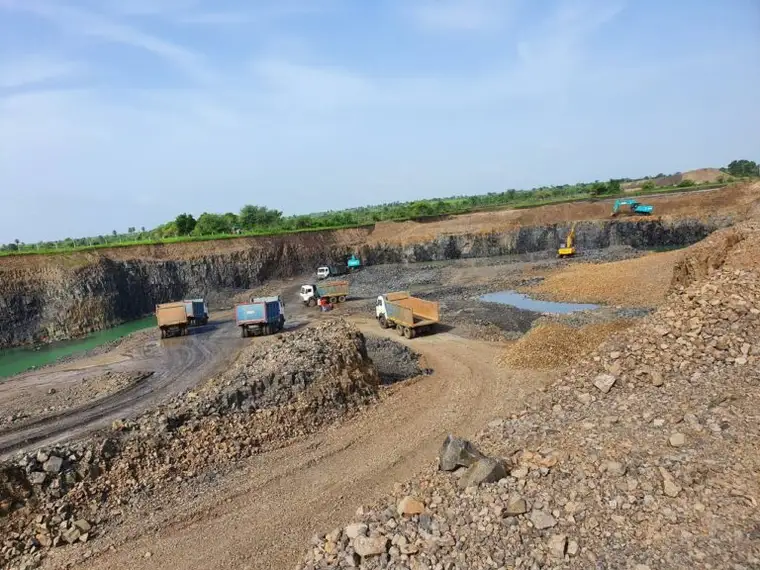
Soil and murrum are dug by excavator and loaded straight to tippers. Weathered rock may need ripping with a dozer, or light blasting where a hard cap sits over softer material. None of this is difficult. What makes it expensive is distance, since every cubic metre has to be carried to a dump and the dump is never as close as one would like.
04Where it goes
- Topsoil is stripped first and stacked on its own, low and wide, for re-spreading when a part of the quarry is finished. Mixed into the general dump it is lost.
- The main dump goes on ground that will never be quarried. Dumping over future reserves is the commonest and most expensive mistake in a small quarry, because the same material is then moved a second time.
- A bund along the boundary uses some of it, screens the working from neighbours and keeps surface water out of the pit.
- Usable fill goes to whoever needs embankment material. A highway package next door often does.
05How it is measured and paid
Overburden removal is normally paid per cubic metre in the bank, from survey levels taken before and after, with the lead to the dump stated. Remember that it swells by a quarter or more once dug, so truck counts will exceed the surveyed volume. The conversion is in bank, loose and compacted.
Where a mining and crushing contractor is paid per tonne of finished stone, stripping is either a separate item or is built into the tonne rate on an assumed depth. Ask which. If it is built in and the cover turns out deeper than assumed, somebody will want to reopen the rate.
06Strip ahead of the face
Stripping should run a season ahead of production, not alongside it. A face that advances into uncleared ground brings soil and clay down with the rock. That clay ends up in the fines, the plasticity index of the GSB rises, and material that was within limits last month starts failing. The cause is fifty metres back from the crusher, on top of the bench.
The dry months are the time to do it. Wet overburden is heavy, sticks in tipper bodies and turns dump ramps to slides.