
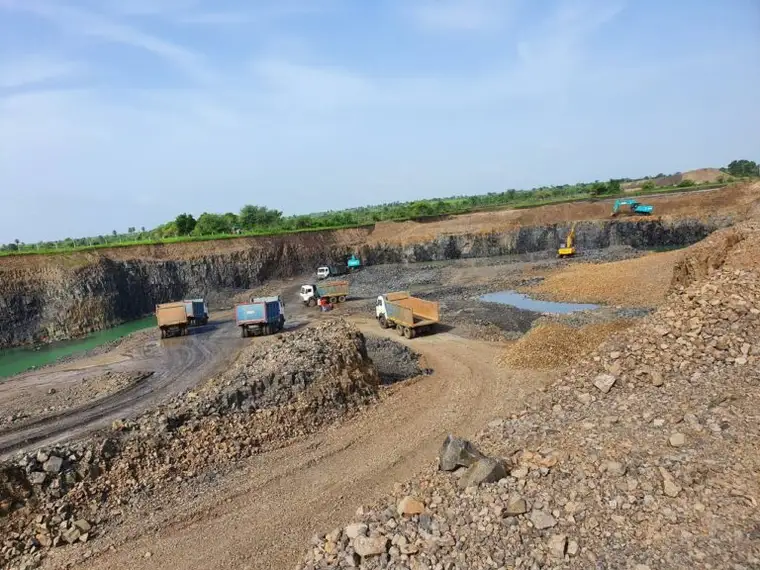
The short answer
A stone quarry for a highway package needs, at the least: a mineral concession or project permit from the state mining department, prior environmental clearance from the state authority, consents from the Pollution Control Board, notice to the mines safety directorate with a qualified manager appointed, and a lawful arrangement for explosives. With those in hand, mobilisation, stripping and benching take three to six weeks before the first saleable tonne.
The rock is the easy part. A quarry is opened on paper first, across five or six offices that do not talk to each other, and the paper takes several times longer than the stripping does. This is a map of that process. State rules differ in the detail, so treat it as the list of questions to put to the district offices and not as a substitute for them.
01The approvals
| Permission | Issued by | What it allows |
|---|---|---|
| Quarry lease, licence or project-specific permit | State Department of Mines and Geology | The right to extract the mineral, against royalty |
| Approved mining plan | State mining department | How the pit will be worked and closed |
| Environmental clearance | State Environment Impact Assessment Authority | Mining at that location, on stated conditions |
| Consent to Establish and Consent to Operate | State Pollution Control Board | Running the quarry and any crusher under the air and water laws |
| Notice of opening, appointment of manager | Directorate General of Mines Safety | Starting mining operations lawfully |
| Permission for deep-hole blasting or heavy machinery | Directorate General of Mines Safety | Mechanised working, on the conditions set |
| Explosives licence or licensed supply | Petroleum and Explosives Safety Organisation | Possessing and using explosives |
| Land rights and, where relevant, forest clearance | Revenue and forest departments | Entering and using the land |
02The mineral right
Stone is a minor mineral, and each state regulates it under its own concession rules. A long-term quarry lease is one route. Most states also provide a shorter permit tied to a specific public works contract, which lets a highway contractor extract a stated quantity for that project. The second is quicker to obtain and ends with the project. Ask the district mining officer which applies, what quantity it will cover, and whether royalty is paid in advance or as stone is dispatched.
03Environmental clearance
Prior environmental clearance is required for every minor mineral lease, including those under five hectares. Small leases are appraised at state level as Category B2. Where several leases lie within 500 m of each other and together exceed five hectares, they are treated as a cluster, and a full environmental impact assessment with a public hearing is needed. The district survey report for the mineral has to be in place too.
This is usually the longest single item, and it is the one that cannot be hurried by spending money. Start it the week the land is identified.
04Mines safety
A stone quarry is a mine in law. Before work begins the owner gives notice of opening and appoints a manager holding the prescribed qualification. Working with deep-hole blasting or heavy earthmoving machinery, which describes every production quarry on a highway job, needs prior notice to the Directorate under Regulation 106 of the Metalliferous Mines Regulations, and the work then proceeds on the conditions the Directorate sets: bench height, haul road gradient, danger zone and more.
New mines regulations under the Occupational Safety, Health and Working Conditions Code were published in draft in 2026. Until they are notified in final form the 1961 regulations are the working rules. Confirm the current forms and notice periods with the regional office before filing.
05Explosives
There are two ways to have explosives on a quarry lawfully. One is a licensed magazine on or near the site. The other is delivery on the day of the blast by a licensed van from a supplier's magazine, with anything unused returned the same day. The first suits a quarry blasting several times a week. The second avoids the time it takes to site, build and license a magazine. Either way, shots are fired by a certified blaster. The detail is in explosives on site.
06Run them in parallel
Most of these applications depend on a common set of documents: land records, a surveyed plan of the area, the mining plan. Once those exist, the applications can go in together. Filed one after another, each waiting for the last, they add up to a year. Filed together and chased weekly by one named person, they take a fraction of that.
Until they are complete, stone has to be bought. The decision between the two is weighed in captive quarry or bought-in aggregate.
07The first six weeks on the ground
- Survey. Boundary pillars fixed, levels taken, rock type and overburden depth confirmed, haul route and plant site chosen.
- Mobilisation. Excavators, drills, compressors, tippers and crew move in. Camp, fuel store, workshop and the explosives arrangement are set up before production, not alongside it.
- Stripping. Topsoil stacked separately, overburden carried to a dump clear of future benches.
- Benching. The first working bench is cut to a geometry that can be drilled, blasted and loaded safely, and repeated.
- Haul road. Graded and drained from the face to the hopper before the tippers start wearing it out.
- First shots. Small, monitored, and used to settle the pattern for this rock.
Two of those weeks are mobilisation. The rest goes on stripping and cutting a bench to work from. Stripping is covered in overburden removal and the bench in bench height, width and slope.