
The short answer
A crusher plant on a highway project needs a level site of a few acres with a road a low-bed trailer can use, grid power or generators, water for dust suppression, and Consent to Establish followed by Consent to Operate from the State Pollution Control Board. The steel goes up in about a fortnight. The consents and the siting rules usually take longer than everything else put together.
Erecting a plant is the quick part. A good crew raises a three-stage unit in two weeks. What decides the date of the first tonne is the list of things that have to be true about the ground before the trailers arrive.
01The site
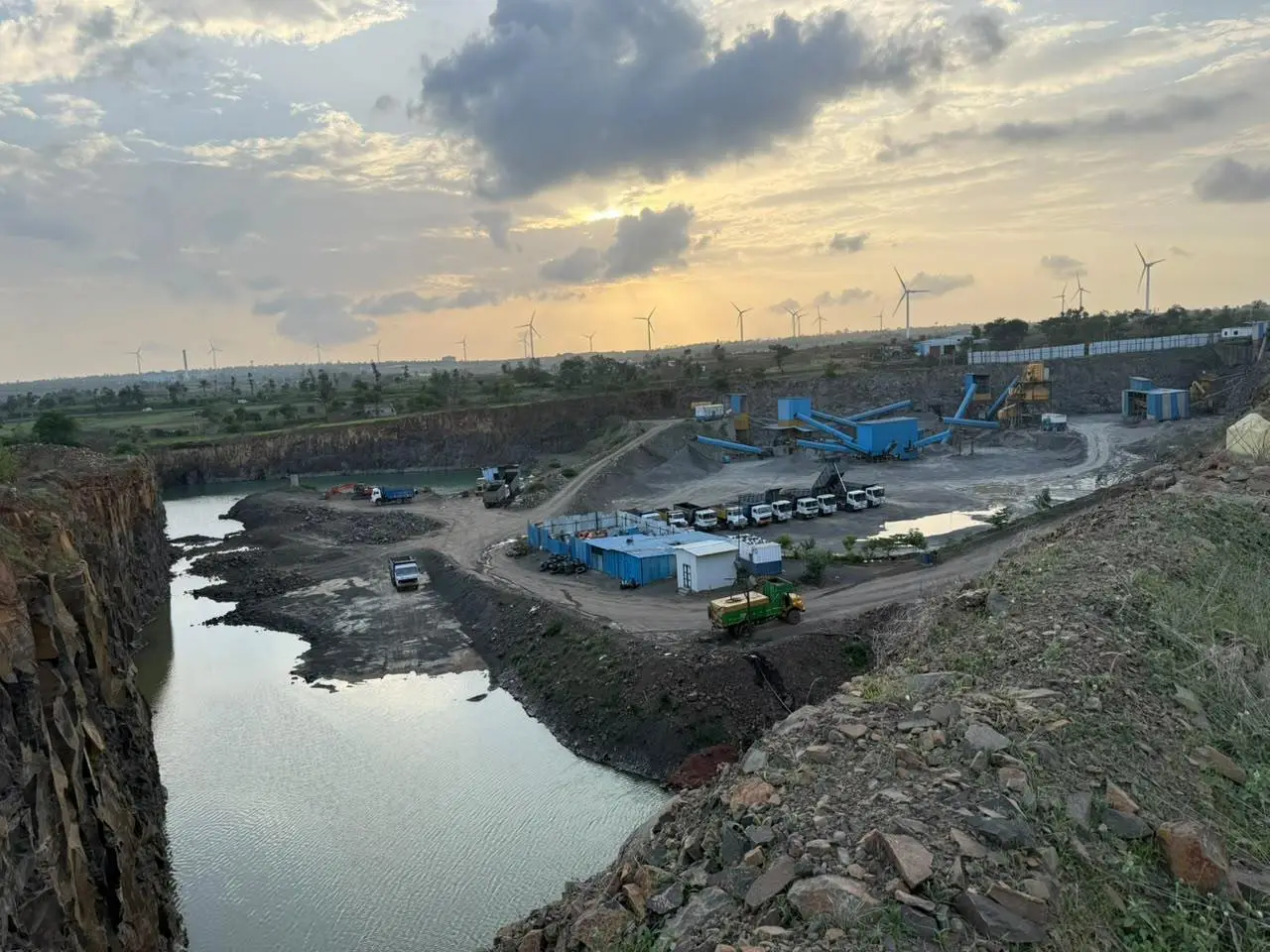
As a guide, a 250 TPH three-stage plant with its stockpiles, weighbridge, workshop and truck circulation is comfortable on four to five acres and cramped on two. The plant itself takes little of that. The stockpiles take most of it, because each product needs its own heap with room for a loader to work and a tipper to turn.
- Level standing for the plant, on ground that will carry foundations. Filled ground needs time or treatment.
- A height difference, if the land offers one. Putting the feed hopper at the top of a natural slope saves building a ramp.
- An approach road that a loaded low-bed can physically use: width, turning radius, bridge and culvert capacity, overhead lines.
- A one-way route for trucks: in over the weighbridge, round the stockpiles and out, without reversing across each other.
- Drainage. A yard that floods in July produces nothing in July.
- Distance from the quarry face, short enough to keep the feed haul cheap and long enough to be outside the blasting danger zone.
02Power
A 250 TPH three-stage plant with a VSI carries a connected load of the order of 600 to 900 kW across the crushers, screens, feeders and conveyors. A high-tension grid connection of that size has to be applied for, sanctioned and built, and on a remote project site that can take longer than the package has to spare. Most project plants therefore start on diesel generators and move to the grid if and when it arrives.
The choice shows up in the rate. Grid power is far cheaper per unit than generated power, which is why electricity or generator diesel is usually kept outside a per-tonne crushing rate and reimbursed or supplied directly. More on that in crushing rate per tonne.
03Water
A dry-process plant uses water for one purpose: keeping dust down, at the hopper, the transfer points and on the roads. A WMM mixing plant alongside adds its own demand. The source has to be lawful. CPCB's guidelines for stone crushers ask for permission where groundwater is drawn, and tankered water has to come from somewhere that can be shown on paper.
04Consents
| Approval | From | When |
|---|---|---|
| Consent to Establish | State Pollution Control Board | Before any construction |
| Consent to Operate | State Pollution Control Board | After erection, before production |
| Siting clearance under the state's crusher policy | Pollution Control Board or district authority | With the Consent to Establish |
| Land: ownership, lease or owner's consent, and permitted use | Revenue authorities | First |
| Electrical installation approval | State electrical inspectorate | Before energising |
| Weighbridge verification and stamping | Legal Metrology | Before trade use |
| Mineral storage or dealer registration, where the state requires it | Department of Mines | Before stocking mineral |
| Groundwater permission, where a borewell is used | Groundwater authority | Before drawing |
A general list. States differ in what they ask for and in the order, so confirm with the regional office before fixing dates.
Siting is the item that surprises people. Most states set minimum distances between a crusher and highways, habitation, schools, hospitals and water bodies, and some confine new crushers to designated zones. A site that suits the project perfectly can fail on one of those distances. Check the state's rule against a map before anything else is spent.
The pollution control side, including the emission standard the plant has to meet once it is running, is in dust control at a stone crusher.
05A realistic sequence
- Choose the site against the siting rule, the approach road and the lead to the road head.
- Secure the land and apply for Consent to Establish.
- While that is pending, settle the layout, order long-lead items and arrange power.
- On consent, cast foundations. They need about a week to gain strength before steel goes on them.
- Move the plant in and erect it: roughly two weeks from the trailers arriving, where access is reasonable.
- Commission: dry run, then material, then samples to the laboratory until the grading holds.
- Obtain Consent to Operate and have the weighbridge stamped before the first invoiced tonne.
Steps two and three run in parallel if someone is managing them. Left to run one after another, they are how a four-month programme becomes eight.
06Who brings what
On a per-tonne crushing contract, the usual split is that the site belongs to the client and the plant belongs to the contractor. The client provides land, approach, water and usually power. The contractor provides the plant, foundations, erection, crew and the plant's own compliance. The consents may sit with either, depending on whose name the unit is established in. Decide that at the start, because the party whose name is on the consent is the one the Board will write to.