
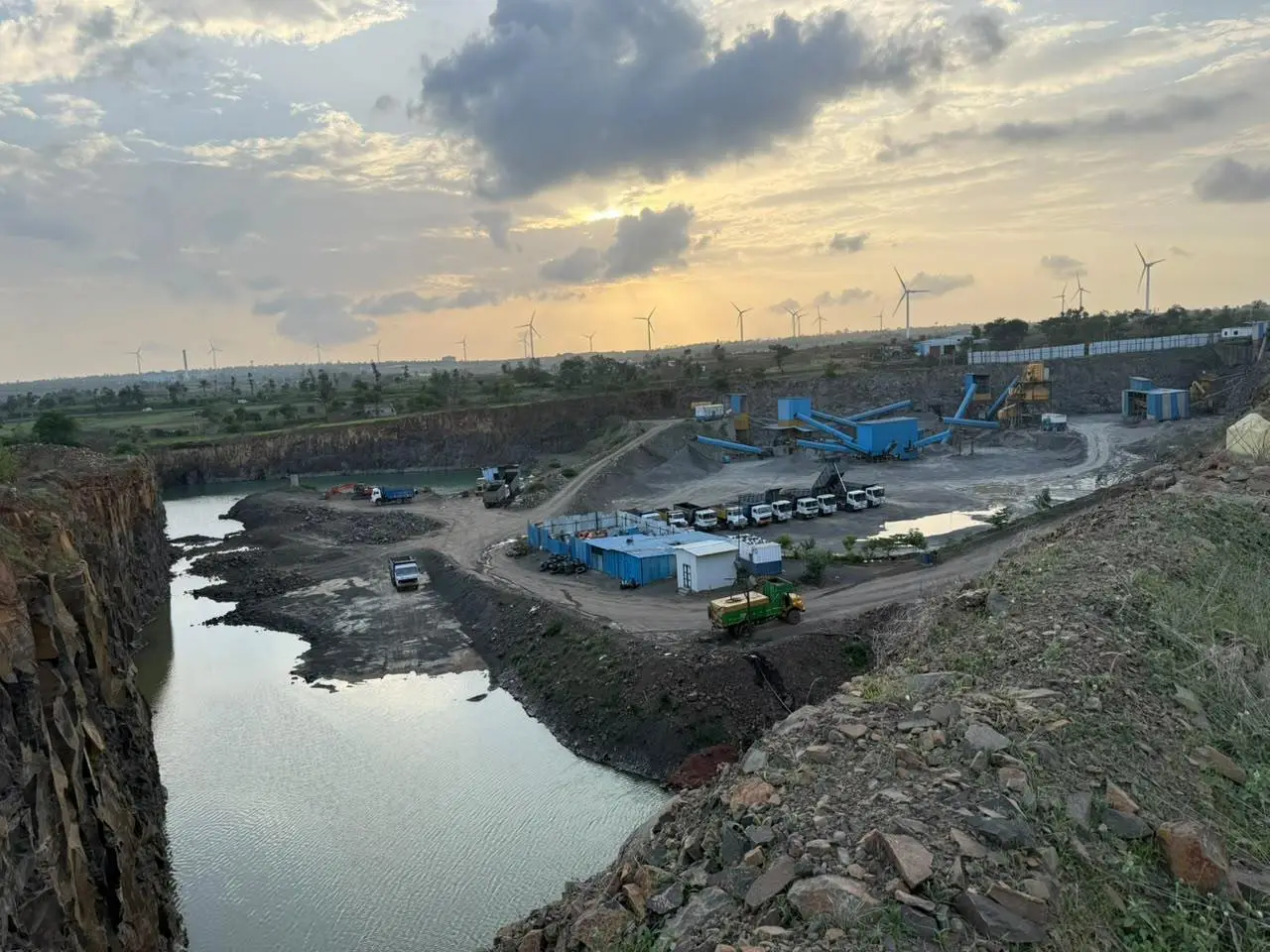
The short answer
The emission standard for stone crushers under the Environment (Protection) Rules is suspended particulate matter of no more than 600 micrograms per cubic metre, measured 3 to 10 metres from any process equipment. CPCB's 2023 guidelines set out the means: enclosures on crushers and screens, sprinklers at every transfer point, dust extraction on the fine stages, wind-breaking walls, paved and wetted roads, covered fines and a green belt.
A crusher makes dust at every point where stone is broken, dropped or driven over. Controlling it is partly equipment and mostly housekeeping, and an inspector can tell which kind of plant it is before reaching the office.
01The standard
The number is 600 micrograms of suspended particulate matter per cubic metre of air, measured between 3 and 10 metres from any process equipment of the unit. It applies to the plant as it runs, not to a design. Meeting it at the crusher and failing it at an open conveyor transfer is still failing.
02Where the dust comes from, and what stops it
| Source | Control |
|---|---|
| Tipping into the feed hopper | Sprinklers at the hopper, three-sided enclosure |
| Primary, secondary and tertiary crushers | Enclosure, water spray at the discharge, dust extraction on the fine stages |
| Vibrating screens | Covered on top and three sides, extraction to a bag filter |
| Conveyor transfer points | Enclosed chutes, spray nozzles, short drop heights |
| Discharge onto stockpiles | Low drop, telescopic or adjustable chutes, sprays |
| Fine stockpiles | Covering, wind-breaking wall on the windward side |
| Internal roads | Metalled surface, regular watering |
| Loaded trucks | Tarpaulin cover before leaving the yard |
| The boundary | Wind-breaking wall and two to three rows of trees |
03What CPCB's guidelines add
- Both Consent to Establish and Consent to Operate from the State Pollution Control Board.
- Siting in line with the state's own policy, including any designated crusher zones.
- A lawful, documented source for the raw stone.
- Permission for groundwater where it is used.
- A health survey of workers every six months.
The last item reflects what the dust does. Fine silica from crushing hard rock causes silicosis, which is permanent. The people breathing the most of it are the plant's own crew, a long time before any neighbour is affected.
04The trade-off with water
Water is the cheapest control and the easiest to overdo. Too little and the dust flies. Too much and the damp fines plaster the screen decks, the openings close up and the grading drifts out. A plant has to find the rate that settles dust at each point without wetting the product, which is why well-run plants use fine mist nozzles at the transfer points instead of a hose at the hopper. Dry extraction to a bag filter avoids the problem on the fine stages, at a capital cost.
05What an inspector looks at
- Whether the consent is current and displayed.
- Whether enclosures are in place or lying beside the machines they were removed from.
- Whether the sprinklers are working at the time of the visit, with nozzles clear.
- The state of the roads and whether a tanker is actually running.
- Dust on the leaves of the green belt and on neighbouring crops.
- Records: water consumption, monitoring results, health checks.
Covers removed for maintenance and never refitted are the commonest finding, and the cheapest to avoid.
06On the quarry side
Drilling is a dust source of its own, controlled by water at the collar or a collector on the rig. Haul roads between the face and the plant are another, and usually the largest by area. A water tanker on a fixed round does more for a site's dust than any single item on the plant. The roads themselves are covered in haul road design.
Where a plant is being planned, the consents and the siting rules are set out in setting up a stone crusher plant.