
The short answer
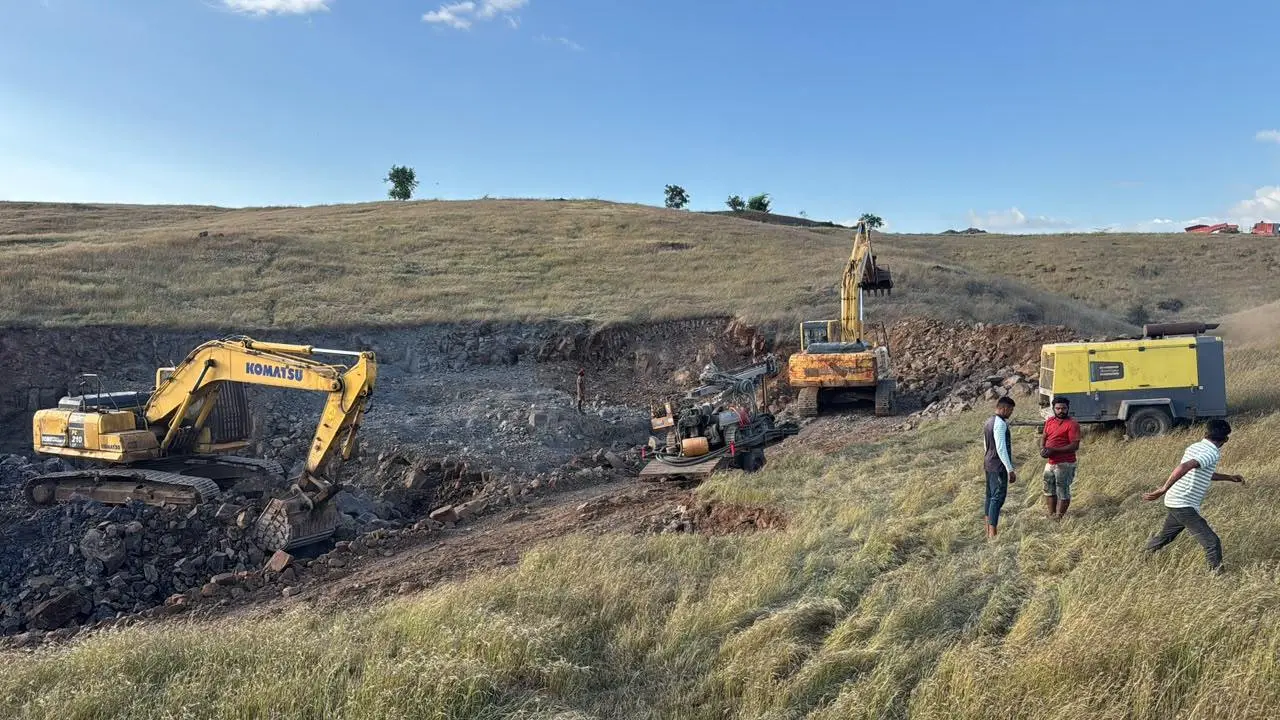
A hand-held jackhammer drills 32 to 34 mm holes to about 3 m and suits low benches, toe holes and popping boulders. Production benches of 6 m and more need a crawler or wagon rig: top hammer for 64 to 115 mm holes in competent rock where speed matters, and down-the-hole (DTH) for 90 to 165 mm holes where depth and a straight hole matter more.
Four machines put most of the blast holes into Indian quarry rock. They overlap at the edges, and a contractor who owns only one kind will tell you it suits your job. This is how to check.
01The four machines side by side
| Rig | Hole diameter | Practical depth | Compressed air | Where it belongs |
|---|---|---|---|---|
| Jackhammer, hand-held | 32 to 34 mm | 1.5 to 3 m | About 80 to 130 cfm at 6 to 7 bar each | Low benches, toe holes, boulders, trenches |
| Wagon drill, pneumatic | 64 to 100 mm | Up to about 18 m | 365 to 600 cfm at 7 to 10 bar | Small quarries, low capital, slow moves |
| Crawler, top hammer | 64 to 115 mm | Up to about 20 m | On board, hydraulic drifter | Fast metres in medium to hard sound rock |
| Crawler, DTH | 90 to 165 mm | 30 m and more | 600 to 1,100 cfm at 14 to 24 bar | High benches, broken or abrasive rock |
Figures are typical working ranges. A manufacturer's sheet for a particular model will differ at the margins.
02Where the hammer sits
The difference between top hammer and DTH is in the name. On a top hammer rig the piston strikes at the top of the drill string and the blow travels down the rods to the bit. Every coupling loses a little of it. At 6 m that hardly shows. At 20 m the bit is receiving noticeably less than the drifter is delivering, the rods are flexing, and the hole is starting to wander.
A DTH hammer rides down the hole directly behind the bit. The blow has nowhere to get lost, so the last metre drills much like the first, and the stiff tube string keeps the hole straight. The price is air. A DTH hammer is driven by the same compressed air that flushes the cuttings, at two or three times the pressure a wagon drill uses, and that compressor burns diesel every minute the rig turns.
So the rule of thumb is short. Shallow holes in sound rock: top hammer, because nothing puts metres down faster. Deep holes, bad ground or a pattern that cannot tolerate deviation: DTH.
03Air decides the day's metres
A rig is sold by its engine and judged by its compressor. Air does two jobs at once. It drives the hammer, and it lifts the cuttings out of the hole. When the air falls short the cuttings stay at the bottom, the bit regrinds the same rock, and the penetration rate drops while the fuel gauge does not.
This shows up on site as a rig that drills well for the first three metres and slows from there. Before blaming the operator, look at the compressor's rated delivery against what the hammer asks for, the length and bore of the hose between them, and whether somebody has teed a second machine off the same line.
04Matching the hole to the bench
Hole diameter fixes the burden, and the burden has to suit the bench height. A hole carries a burden of roughly 30 diameters, and a bench works properly when it is at least twice the burden in height. Run that through and a 110 mm hole wants a bench of 6.5 m or more, while a 34 mm jackhammer hole, with a burden near 1 m, suits benches of 2 to 3 m. The ratios are set out in reading a drilling pattern.
The common mismatch runs one way. A quarry opens on a low bench, a big rig arrives because it is the rig available, and the first shots throw rock and leave a toe. The fix is to drill small until the bench has height, then bring the crawler in.
05What hard rock does to the steel
Bits, rods and hammers are consumables, and the rock sets the rate. Abrasive stone wears the gauge buttons on a bit until the hole is being drilled undersize and the bit jams. Buttons need regrinding on a schedule, not when they have gone flat, because a flat button pushes the load onto the steel body and cracks it.
A drilling rate quoted without seeing the rock has assumed a bit life. In soft sandstone one bit may last many hundreds of metres. In fresh granite it can be a small fraction of that, and the rate per metre has to carry the difference.
06Six questions for a drilling contractor
- Which rigs, by type and hole diameter, and what is the rated delivery of each compressor?
- What metres per shift do you expect in this rock, and on which earlier job did you measure it?
- Who tapes the depth and checks the inclination before the rig leaves the collar, and where is it written down?
- How is dust handled at the collar: water, or a collector on the rig?
- What stands in when a compressor fails mid-pattern?
- Is the rate per metre drilled or per cubic metre broken, and who carries redrilling when a hole is lost?
The answers tell you whether you are hiring metres or hiring a pattern. Our own arrangement is on the drilling services page.