
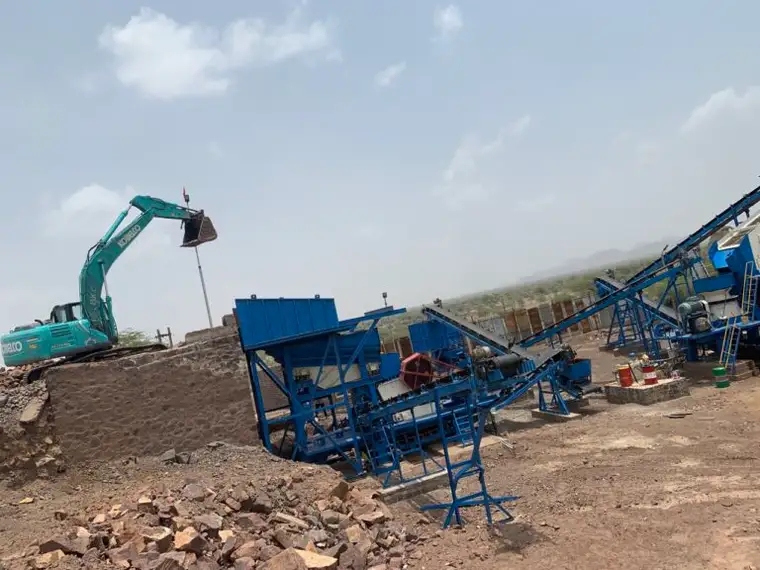
The short answer
The jaw crusher takes blasted rock of up to about 700 mm and squeezes it down to 150 mm or so. The cone crusher takes that and makes 40 mm and below. The third stage, usually a vertical shaft impactor, shapes the stone and produces the 20 mm, 10 mm and sand fractions. Screens between the stages sort the product and send oversize back round.
A crusher plant is a line of machines that each do one modest job. No single crusher takes a boulder to a chip. The stone is brought down in steps, and the screens decide which step each piece goes to next.
01The three stages
| Stage | Machine | Feed size | Product size | Reduction | What it governs |
|---|---|---|---|---|---|
| Primary | Jaw crusher | Up to about 700 mm | 100 to 200 mm | 4 to 6 : 1 | How many tonnes the plant can take in |
| Secondary | Cone crusher | Up to about 200 mm | 40 to 50 mm and under | 4 to 6 : 1 | Top size of GSB and WMM |
| Tertiary | VSI, or a fine cone | 40 mm and under | 20, 10, 6 mm and sand | 2 to 3 : 1 | Particle shape and the fines |
Sizes are typical for a 250 to 350 TPH plant. The reduction ratio is feed size divided by product size.
Ahead of the jaw sits a vibrating grizzly feeder. It meters rock into the crusher and lets soil, clay and stone that is already small fall through the bars before the jaw has to deal with it. A plant fed straight from a tipper with no grizzly sends its dirt all the way to the product.
02Why two stages are not enough
Taking 700 mm rock down to a 10 mm chip is a reduction of seventy to one. A compression crusher works well at four to six to one. Ask it for more and three things go wrong together: the stone comes out as slivers instead of cubes, the proportion of dust climbs, and the liners wear in weeks instead of months.
Three stages at roughly five, five and three multiply out to seventy-five. Each machine is working inside its comfortable range, and the plant has a place to adjust shape without touching throughput. Two-stage plants exist and they are cheaper. They make acceptable GSB and they struggle with a flakiness limit on 20 mm and 10 mm, which is the subject of flakiness and elongation index.
03The closed side setting
Every compression crusher has a gap at its narrowest point when the moving part is closest to the fixed one. That gap is the closed side setting, and it fixes the top size of what comes out. Open it and the machine passes more tonnes of coarser stone. Close it and you get finer stone, fewer tonnes and faster wear.
The setting does not stay where it was put. Manganese liners wear, the gap opens, and the product coarsens a little every shift. A plant that checks its setting weekly drifts out of grading between checks. One that checks it daily does not.
04Keeping the cone full
A cone crusher gives its best shape when the chamber is choked with stone, so that pieces break against each other as well as against the steel. A cone fed in a trickle breaks each stone once between two metal faces and produces flat pieces. This is why a surge bin or a stockpile sits between the jaw and the cone: the jaw's output comes in lumps, and the cone wants a steady head of feed.
05What the VSI adds
A vertical shaft impactor throws stone outward from a spinning rotor at high speed into a wall of stone or steel anvils. It does not squeeze. Stones strike and chip each other, weak corners and flat pieces break off, and what survives is rounder and stronger. The same action makes a large amount of fine material, which is the source of manufactured sand.
So the tertiary stage is where a plant is tuned for the bituminous and concrete sizes. Rotor speed up gives better shape and more sand. Speed down gives more chips and less dust. The trade-off between them is explained in crusher dust, M-sand and river sand.
06Screens do the grading
Crushers make a spread of sizes. Screens make products. A deck is a sheet of woven wire or rubber with square openings, and a vibrating screen stacks two, three or four of them so that one pass separates several fractions. Stone too large for the top deck is sent back to the crusher, which is called running in closed circuit.
Screens fail quietly. Damp fines plaster the wire and close the openings, which is blinding. Stones a shade larger than the opening wedge in and stay there, which is pegging. Either way less material gets through, undersize rides over into the coarse product, and the grading shifts without anything on the panel changing. Looking at the decks is a daily job.
07Where each product comes off
- GSB is drawn after the secondary stage, as a blend of the coarse and fine fractions that meets the sub-base grading.
- WMM is proportioned from 40 mm down through the fines and mixed with water in a pugmill before it leaves.
- 40 mm, 20 mm and 10 mm come off the final screens as single sizes.
- Crusher dust is what passes the bottom deck.
Changing from one product to another is a matter of deck apertures and chute positions. On our plants that is a shift of fitting work. The seven products and the layer each belongs in are on the materials page.